

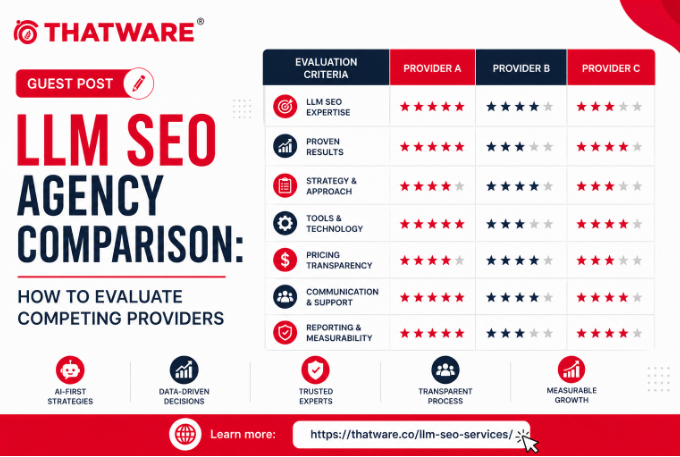
Comparing LLM SEO agencies without a framework is a recipe for making decisions based on who has the nicest website or the most confident sales rep. Neither correlates with results. Here’s how to actually evaluate competing providers — with enough rigor that you’re making an evidence-based choice rather than an impression-based one.
Build a Comparison Matrix Before You Talk to Anyone
Start by defining your evaluation dimensions before you enter any sales conversation. Once you’re in the process, every agency will frame themselves favorably, and it’s hard to maintain objectivity. Decide in advance what matters most: technical depth, content quality, citation tracking capability, industry specialization, pricing, reporting transparency, or some combination.
Weight those dimensions based on your specific situation. A Series B SaaS company doing a rigorous LLM SEO agency comparison might weight technical depth and reporting heavily. A boutique professional services firm might weight industry specialization and content authority more heavily. There’s no universal right answer.
The Discovery Call as Evaluation Tool
Use your discovery calls deliberately. Ask: “Can you walk me through the technical difference between how Perplexity citations work versus Google AI Overviews?” Good agencies will give you a nuanced answer. Ask: “What does your citation tracking look like, and how would you report progress?” If they struggle to answer this clearly, their measurement capability is probably weak.
References and Case Studies
Don’t accept case studies at face value. Ask to speak directly with a client in a similar industry who has been engaged for at least six months. Ask that client specifically whether they can see LLM citation impact, not just content metrics improvement.
Reading LLM SEO services reviews across independent platforms can add context, but be appropriately skeptical — the space is new enough that review quality is uneven and the incentives for agencies to game them are strong.
Trial Engagements and Audits
Many of the stronger agencies will offer a paid initial audit before committing to a full retainer. This is valuable on multiple levels: you get a concrete deliverable you can evaluate, you see firsthand how they think and communicate, and you create a natural decision point without a long-term commitment lock-in.
If an agency is resistant to a standalone audit phase and pushes immediately for a 12-month contract, that’s worth noting. Agencies confident in their work are generally happy to let the audit speak for itself.
Final Evaluation
After discovery calls, reference checks, and audit deliverables, you should have a reasonably clear picture of which agency demonstrates the right combination of technical sophistication, content depth, and measurement rigor for your needs. Trust that picture more than the pitch. The ones who answer hard questions well are almost always the ones who deliver well too.